Intro.
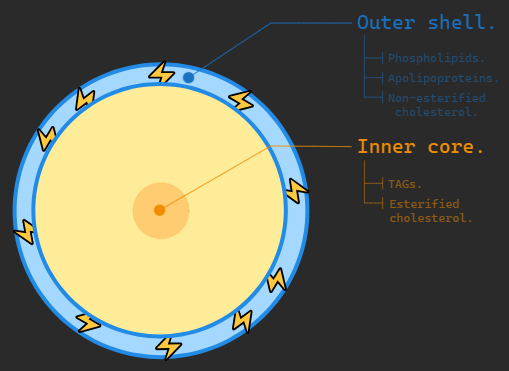
Lipoproteins are spherical macromolecules. They are complexes of lipids and proteins and are classified according to the contents of each. They are: Chylomicrons, VLDL, LDL, and HDL. They exist to transport lipids to and from tissues. They have a neutral lipid core (TAGs and esterified cholesterol) surrounded by a shell of amphipathic compounds (phospholipids and apolipoproteins) as well as non-esterified cholesterol. Chylomicrons transfer TAGs from the intestines to the tissue. VLDLs transfers TAGs from the liver to the tissue. LDL transfers cholesterol from the liver to tissues while HDL transfers cholesterol from tissues to liver.
| According to: | Size | Density | Electrophoretic mobility |
|---|---|---|---|
| Highest | Chylomicrons (protein < lipid) | HDL | HDL |
| - | VLDL | LDL | VLDL |
| - | LDL | VLDL | LDL |
| Lowest | HDL (protein > lipid) | Chylomicrons | Chylomicrons |
Apolipoproteins overview.
They act as recognition sites for cell receptors and are necessary for lipoprotein metabolism. Some lipoproteins are structural and are non-transferrable, while others can be transferred between lipoproteins (Apo-C and Apo-E.)
Chylomicrons.
They are assembled in the intestinal mucosa and carry TAGs (mainly), cholesterol, vitamins, etc…
Chylomicron assembly.
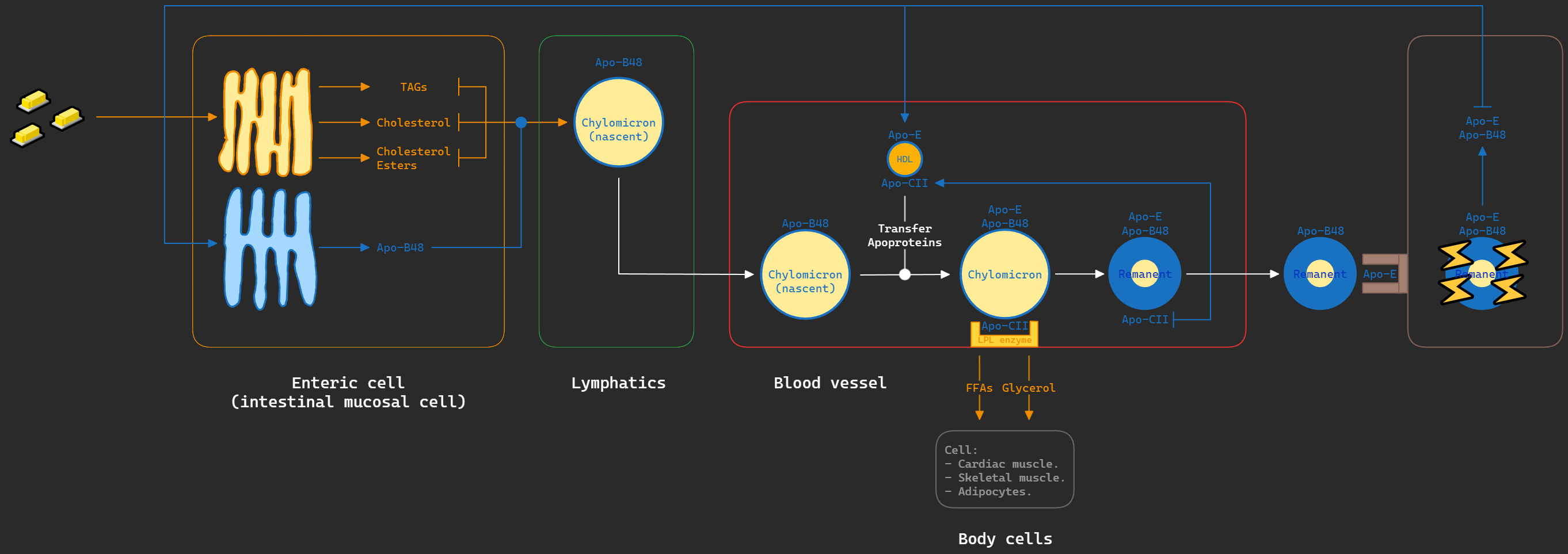
First of all, synthesis of TAGs, cholesterol, and cholesterol esters (AKA the “passengers” of chylomicrons) from dietary fats occurs in the SER of enteric (intestinal) cells. They combine with Apo-B48 synthesized in the RER as well as with some phospholipids creating the final product: a nascent chylomicron. The chylomicron is then secreted in the lymphatics and eventually reaches the blood.
Chylomicron modification.
Once the nascent chylomicron reaches the blood stream, circulating HDL gives it Apo-CII and Apo-E lipoproteins which are needed for the chylomicron’s functionality. (Apo-CII is needed to activate lipoprotein lipase enzyme. Apo-E is needed to bind to liver cell receptors during degradation.)
Chylomicron degradation.
LPL (lipoprotein lipase) enzyme is present on capillary endothelial cells and requires Apo-CII as a co-enzyme. Once it is activated by the Apo-CII on a circulating chylomicron, it begins to breakdown the stored TAGs inside the chylomicron to FFAs and glycerol.
Chylomicron remanent.
Once the TAG core of a chylomicron is degraded, the chylomicron becomes smaller and denser. Apo-CII lipoproteins are returned back to circulating HDL. The remaining molecule is called a “remanent” and goes to the liver which recognizes Apo-E and hydrolytically degrades it (Apo-E receptor is recycled.)