Intro.
The arterial supply of the upper limbs is delivered through 5 main arteries:
- Subclavian artery.
- Axillary artery.
- Brachial artery.
- Radial artery.
- Ulnar artery.
- Palmar arches. (for the hands.)
Subclavian artery.
Origin.
- On the right side of the body, subclavian artery arises from the brachiocephalic artery trunk.
- On the left side of the body, subclavian artery arises from the aortic arch.
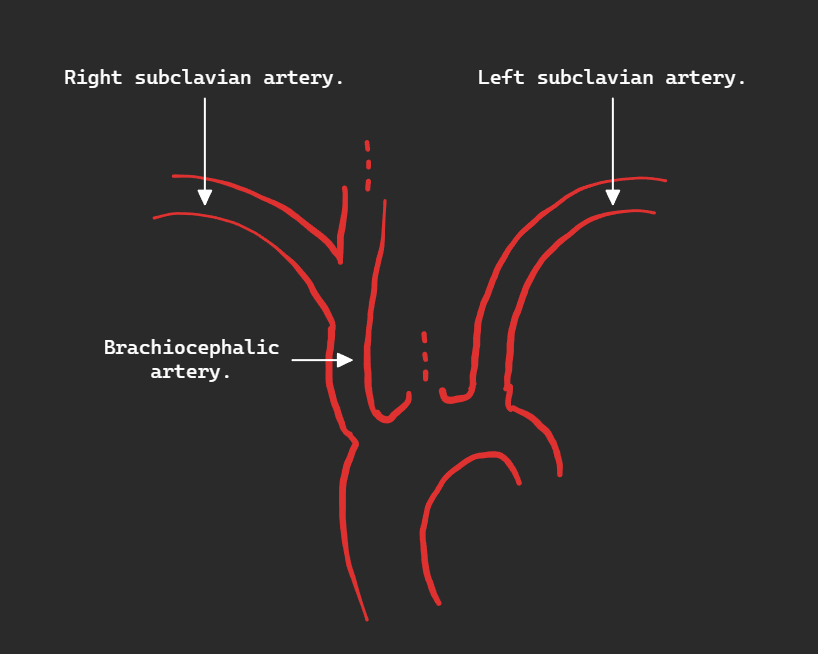
Course and parts.
The subclavian artery moves laterally towards the axilla, it can be divided into 3 parts relative to the anterior scalene muscle.
- First part: from origin to medial border of anterior scalene.
- Second part: posterior to anterior scalene.
- Third part: from lateral border of scalene to the lateral border of first rib.
Branches.
The first part has 3 branches, the second part has 1 branch and the third part has 1 branch.
- First part branches. ^fdd92f
- Vertebral: supplying the medulla, cerebellum, and brain.
- Internal thoracic artery: supplying the thoracic wall and breast tissue.
- Thyrocervical trunk: supplies blood to the thyroid and neck area.
- Second part branches.
- Costocervical: supplying upper thorax and posterior deep cervical muscles.
- Third part branches.
- Dorsal scapular artery: supplying muscles of the upper back and shoulders.

End.
The subclavian artery ends at the end of its third part, i.e. at the lateral border of the first rib, at which point it becomes the axillary artery.
Axillary artery.
Origin.
Begins where the subclavian artery ended, at the lateral part of the 1st rib.
Course and parts.
The axillary artery lies deep to the pectoralis minor muscle and is enclosed in an axillary sheath.
- First part: proximal to pectoralis minor.
- Second part: posterior to pectoralis minor.
- Third part: distal to pectoralis minor.
Branches.
Each part in the axillary branch branches according to its name, first part has 1 branch, second part has 2 branches, and third part has 3 branches.
- First part branches.
- Superior thoracic artery.
- Second part branches.
- Thoracoacromial artery.
- Lateral thoracic artery.
- Third part branches.
- Subscapular artery.
- Anterior circumflex artery.
- Posterior circumflex artery. (The anterior and posterior circumflex arteries form a network around surgical neck of humerus.)
End.
The axillary artery ends at the lower border of the teres major muscle, at which point it becomes the brachial artery.
Brachial artery.
Origin.
Begins where the axillary artery ends, at the lower border of the teres major muscle. It is the main blood supply of the arm.
Course.
The brachial artery branches into the profunda brachii immediately distal to the teres major. It continues moving downwards until it reaches the cubital fossa at which point it bifurcates into the radial and ulnar arteries.
Branches.
- Profunda brachii: supplying posterior aspect of the arm. Ending in anastomotic network around the elbow. (bifurcates from the posterior portion of the brachial artery below the teres major’s inferior border.)
-20240506065401142.png)
- Superior ulnar collateral: shares in anastomotic network around the elbow.
- Inferior ulnar collateral: shares in anastomotic network around the elbow.
- Nutrient artery of the humerus.
End.
Ends in the cubital fossa after bifurcating into radial and ulnar arteries.
Radial artery.
Origin.
From the brachial artery at the neck of the radius.
Course.
- Along the lateral aspect of the forearm, deep to the brachioradialis muscle.
- Lateral to the radial artery is the superficial branch of radial nerve.
- Covered by superficial fascia, deep fascia, and skin in distal forearm (wrist.)
Branches.
In the forearm:
- Radial recurrent artery.
- Superficial palmar branch.
-20240504034628104.png)
At the wrist:
- Dorsal carpal branch.
- Palmar carpal branch.
- First dorsal metacarpal branch.
In the hand:
- Princeps pollicis artery.
- Radialis indicis.
- Deep palmar arch.
End.
Moves laterally around the wrist passing through anatomical snuffbox and becomes the deep palmar arch which joins the deep branch of ulnar artery.
Ulnar artery.
Origin.
The ulnar artery is the largest of the two brachial branches (larger than the radial artery.) it is the main vessel of the medial forearm.
Branches.
In the forearm:
- Anterior ulnar recurrent artery contribute to anastomotic network of vessels around elbow.
- Posterior ulnar recurrent artery contribute to anastomotic network of vessels around elbow.
- Common interosseus artery.
- Anterior interosseus artery supplies muscles of the deep forearm and the radius and ulna.
- Posterior interosseus artery supplies the posterior forearm.
In the wrist:
- Dorsal carpal branch.
- Palmar carpal branch.
In the hand:
- Deep palmar branch.
- Superficial palmar arch.
End.
Ends in the superficial palmar arch.
Palmar arches.
Superficial palmar arch.
- Formed by union of the superficial palmar branches of the ulnar and radial arteries.
- Anterior to the flexor tendons, deep to palmar aponeurosis.
- Supplies fingers by digital arteries.
Deep palmar arch.
- Formed by union of deep palmar branches of radial and ulnar arteries.
- Deep to flexor tendons.
- Supplies digits and wrist.
-20240504034419723.png)
Dorsal carpal and first dorsal metacarpal arteries.
As mentioned before, the dorsal carpal branch and the first dorsal metacarpal branch arise at the wrist from the radial artery.
- The dorsal carpal branch gives rise to the dorsal carpal arch giving the dorsal metacarpal arteries which supply the fingers.
- The first dorsal metacarpal branch supplies adjacent sides of the index finger and thumb.
-20240504034712555.png)