Intro.
The heart is a muscular, conically-shaped organ that lies in the thoracic cavity, middle mediastinum that pumps blood around the body. It sits anterior to the spinal column, posterior to the sternum, and is contained in the pericardial sac. Its roughly similar to a fist in size and weighs ~300g.
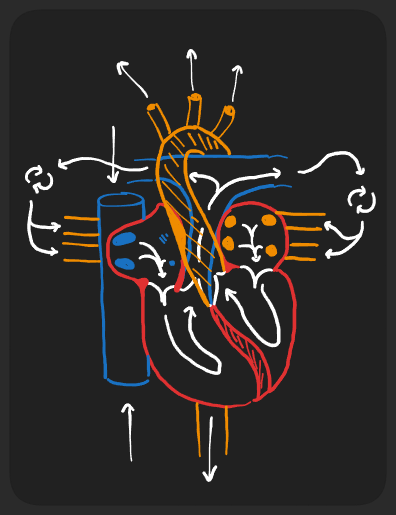
The Atria.
The atriums are the upper two chambers of the heart that are responsible for receiving blood from the body or the lungs. They have distinct auricles externally that can increase capacity if needed.
Right atrium.
The right atrium carries deoxygenated blood that arrives from the body through the SVC, IVC, and coronary sinus. It pumps the blood to the right ventricle through the tricuspid valve.
Left atrium.
The left atrium carries oxygenated blood that arrives from the lungs through the pulmonary veins. It pumps the blood to the left ventricle through the mitral valve.
The Ventricles.
The ventricles are the lower two chambers of the heart that are responsible for pumping blood to the body or lungs. They are larger and thicker than atria.
Right ventricle.
The right ventricle carries deoxygenated blood coming from the right atrium through the tricuspid valve. It pumps the blood to the lungs through the pulmonary trunk & veins.
Left ventricle.
The left ventricle carries oxygenated blood coming from the left atrium through the mitral valve. It pumps the blood to the body through the aorta.
External features.
Surfaces of the heart.
- Anterior surface. (composed of right atrium and ventricle (main) & left ventricle & left auricle.)
- Posterior surface. (composed of left atrium (main) & right atrium.)
- Diaphragmatic surface. (composed of left ventricle (main) & right ventricle.)
- Apex is formed by the left ventricle.
Borders of the heart.
- Upper border. (composed of atria.)
- Right border. (composed of right atrium.)
- Lower border. (composed of right ventricle & apex of left ventricle.)
- Left border. (composed of left ventricle & left auricle.)
Septa of the heart.
- Interventricular septum.
- Interatrial septum.
- Atrio-ventricular septum.
Grooves (sulci) of the heart.
- Coronary sulcus.
- Anterior interventricular sulcus.
- Posterior interventricular sulcus. There is also the sulcus terminalis on the outside where the crista terminals would be from the inside. (See next lecture.)
Pericardium.
The pericardium is a fibro-serous fluid-filled sack that protects the heart from impacts and infection and lubricates its beating motion.
Layers of pericardium:
Fibrous pericardium.
- Tough, prevents overfilling.
- Continuous with central tendon of diaphragm and stabilizes heart.
Serous pericardium.
- Parietal pericardium.
- Lines fibrous pericardium.
- Visceral pericardium.
- Pericardial fluid.
- Prevents friction.
Pericardial sinuses.
Transverse pericardial sinus.
- Posterior to Pulmonary trunk and aorta.
- Anterior to the SVC.
Oblique pericardial sinus.
- Posterior to base of the heart.
- Anterior to structures in posterior mediastinum (esophagus, descending aorta, etc…)